Different Prism in a Bifocal

PATIENT PROBLEM

This patient – let’s call him Frank – has a mild prescription.

The significant challenge for Frank and his eyecare professional is addressing his severe double vision – Frank sees two separate images of the one object.

Double vision is also known as diplopia or binocular visual dysfunction (BVD), with up to 20% of the world’s population suffering from BVD.

Frank’s BVD causes regular headaches, balance problems and dizziness which renders ordinary tasks difficult for him to perform.

Due to the severe nature of Frank’s BVD, he requires prism in his lenses.

However, the extraordinary challenge is that Frank requires a different prism for distance, and a different prism for near.

WHY IS THIS AN ALMOST IMPOSSIBLE SCRIPT?

High prism: 8 dioptres
Different prism for distance and near

The script: Different prism in a bifocal

In this script, Frank requires a prism of 2.5 dioptres for distance, yet 8 dioptres for near vision.

This script is seemingly impossible for two reasons.

Firstly, whenever a patient needs prism in their spectacles, we typically see a prism of 1 to 2.5 dioptres.

Therefore, the first extraordinary part of this script is a prism of 8 dioptres for near vision – this is extremely high and uncommon!

Secondly, the truly nonsensical part of this script is a lens cannot be traditionally manufactured with two different prism scripts in the one lens. For example, if a script has 2 dioptres of prism in the near area, then it automatically has the same 2 dioptres of prism for distance.

As we know, Frank needs two different prisms: 2.5 dioptres for distance and 8 dioptres for near. To cater for two different prism scripts in one lens is impossible to manufacture. Or is it…?

THE IMPOSSIBLE SOLUTION

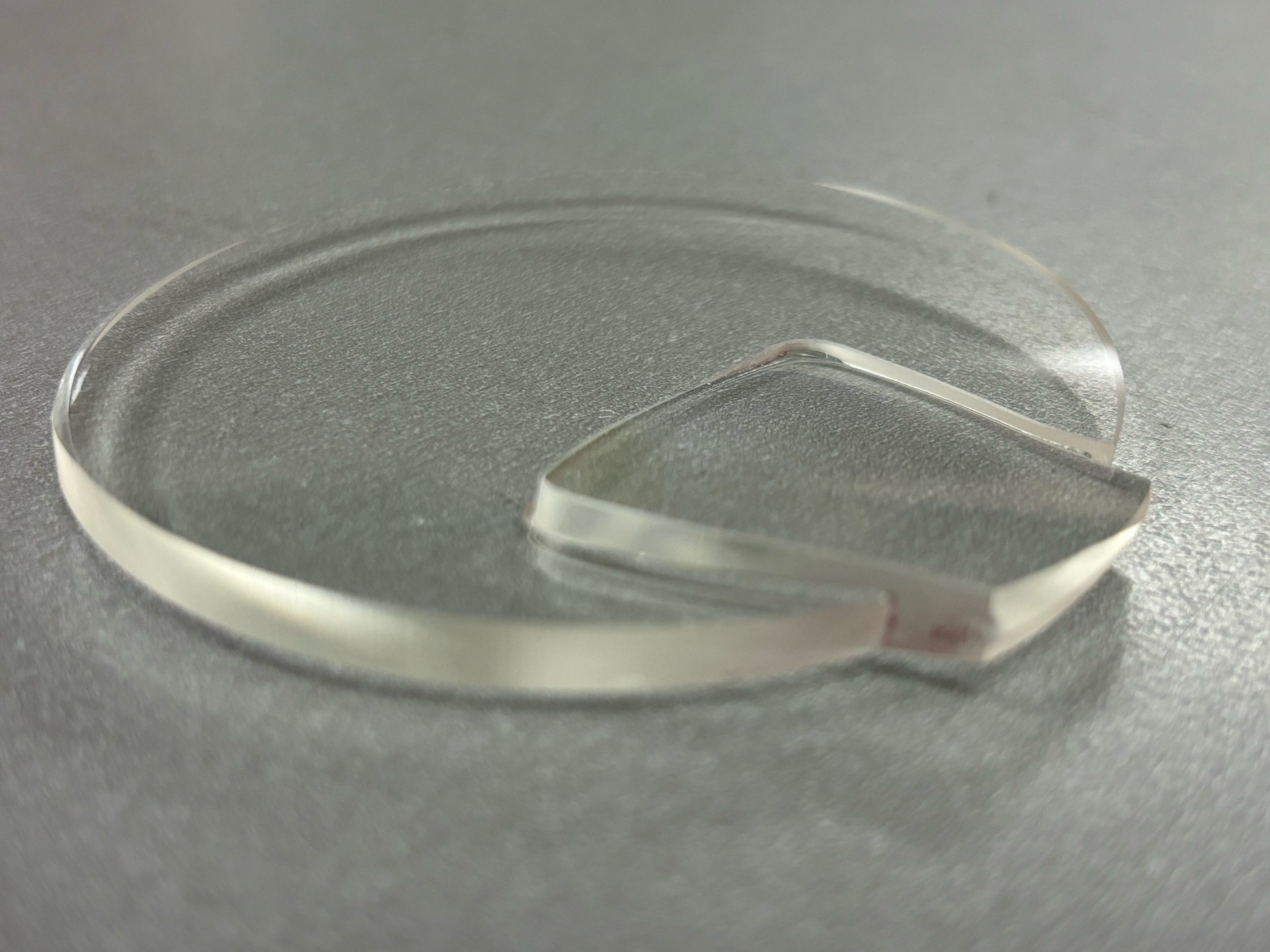
The impossible solution is a truly handmade custom pair of bifocal lenses to address Frank’s differing prism requirements (2.5 dioptres for distance and 8 dioptres for near).

To make these lenses, the ingenious laboratory made up two pairs of lenses: one pair for distance and one pair for reading.

The lab cut out a segment from the distance pair of lenses. They then cut out an identical segment from the near lenses to perfectly slot into the space in the distance lenses. This was UV glued into place.

This impossible solution for Frank means he no longer suffers from double vision! It has transformed his life – Frank feels confident performing everyday tasks and no longer experiences the headaches that frequently plagued him previously.

Does your lab say it can’t be done? Contact Us!

At Younger Optics we have a history steeped in innovation and a swag of optical world firsts under our belt.

As such, we attract and surround ourselves with fellow innovators to cultivate a network of clever optical laboratories. Drawing on this network, we can help you find seemingly impossible solutions for challenging patient scripts!

So next time you encounter an unsolvable script, share your challenge with us. We can refer you to one of these ingenious optical laboratories.

We love providing support to help your patients see better, along with sharing our knowledge and network!

Contact Younger Optics:
Email: info@youngeroptics.com.au
Phone: +61 8 8241 9800

Lab says it can’t be done?

Explore these impossible solutions

Is this even possible?
Click to find out!
Is this even possible?
Click to find out!
Is this even possible?
Click to find out!